
 By Molly Gross, Principal, Power Solutions LLC
When an organization needs three-phase UPS protection, the question is rarely whether to buy a Galaxy. For data centers, critical facilities, and large server environments, Schneider Electric’s Galaxy series is the reference standard. The more useful question is which Galaxy — and why. The VS, VL, and VX are not variations on a theme. They are distinct platforms designed for different scales, architectures, and operating environments.
This article is written for IT directors and facilities managers who are evaluating, specifying, or planning replacements for three-phase power protection infrastructure. It covers what each model does, where each one fits, and what to consider when you’re choosing between them — including the battery decision, which has changed significantly with the maturity of Li-Ion as a practical UPS battery option.
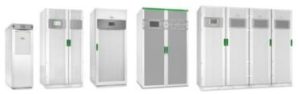
The Three Models at a Glance
All three Galaxy models operate in double-conversion (VFI) mode, support Li-Ion battery configurations, and integrate with EcoStruxure IT for remote monitoring. The differences are in scale, architecture, and the features that become relevant at larger deployments.
Model | Power Range | Primary Voltage | Best Fit |
Galaxy VS | 10–150 kVA | 208V or 480V | Modular three-phase UPS for medium-density IT and critical facilities. Hot-swap power modules; supports internal N+1. |
Galaxy VL | 200–500 kVA/kW | 400V / 480V | Scalable, redundant architecture for large data centers. Add capacity without replacing the base frame. |
Galaxy VX | 500–1,500 kVA | 400V / 480V | Enterprise and hyperscale data centers. Multiple operating modes including ECOnversion (up to 99% efficiency). |
What Double-Conversion Means in Practice
All three Galaxy models are double-conversion (VFI — Voltage and Frequency Independent) systems. Before getting into model-specific selection guidance, it’s worth being precise about what that means operationally, because it’s the specification that matters most for critical infrastructure.
In a double-conversion UPS, utility power is continuously converted to DC and then back to AC. The load is always running on inverter-derived power — it is never directly connected to the utility feed. That means:
- Transfer time is zero. There is no switching event when utility power fails. The output is continuous and uninterrupted because the inverter was already driving the load.
- The output is isolated from utility anomalies. Voltage sags, swells, frequency variations, and harmonic distortion on the input side do not reach the load. The inverter sets the output voltage and frequency independently.
- Battery runtime begins immediately on utility loss. There is no transfer delay during which the batteries must be engaged — the batteries are already part of the active power path through the DC bus.
For transaction processing systems, trading platforms, imaging infrastructure, clinical systems, and any application where a momentary power interruption has downstream consequences, these characteristics are not optional. Line-interactive systems — which transfer in 4–25 milliseconds — are not equivalent, regardless of their runtime specifications.
Galaxy VS: The Right Choice for Medium-Density IT and Distributed Facilities
The Galaxy VS covers 10–150 kVA in a modular, hot-swap architecture. It is available in both 208V and 480V configurations — a practical distinction that matters in facilities with mixed distribution voltage or in environments where 480V reduces downstream panel and wiring costs.
Where the Galaxy VS fits
The VS is the right choice when an organization needs three-phase UPS capability at a scale that doesn’t require the frame-level architecture of the VL or VX. Typical applications include:
- Mid-size data centers and server rooms where a single system can protect the full IT load, with internal N+1 redundancy via hot-swap power modules
- Distributed facilities — regional data centers, satellite offices, or healthcare department server rooms — where a compact three-phase system fits the available space and the load doesn’t justify a VL-class deployment
- Infrastructure refresh projects where an aging single-phase stack is being replaced with properly sized three-phase protection
- Mixed-voltage environments where the 208V/480V availability matters for integration with existing distribution infrastructure
What makes the VS operationally distinctive
The hot-swap power module architecture is the VS’s defining operational advantage. Power modules can be removed and replaced under load — without a maintenance bypass, without a scheduled outage, and without interrupting the protected systems. For IT directors managing environments where downtime carries real consequences, that means planned maintenance events do not require negotiating a maintenance window.
Internal N+1 redundancy is achieved by specifying one additional power module beyond the calculated load requirement. The redundant module is active — not in standby — and the system reconfigures automatically around a failed module without operator intervention. This is meaningfully different from systems that achieve redundancy through parallel frame configurations, which introduce single points of failure at the input/output bus level.
Galaxy VL: Scalable Architecture for Large Data Centers
The Galaxy VL covers 200–500 kVA/kW. It is designed for large data center environments where capacity must grow incrementally without replacing the base infrastructure, and where redundancy needs to be achieved at the frame level rather than the module level.
Where the Galaxy VL fits
The VL is appropriate when the IT load has grown — or is expected to grow — beyond what a single VS installation can serve, and when the operational requirements call for a frame-level scalable architecture. Typical applications include:
- Consolidated enterprise data centers for mid-size organizations, financial institutions, insurance carriers, and health systems running centralized IT infrastructure
- Environments requiring parallel redundancy — where Tier III equivalent availability requires independent UPS systems protecting the same load, and where the VL’s parallel frame capability provides that without the complexity of separate single-system installations
- Data centers planning for load growth where adding capacity means adding to an existing VL frame rather than adding a new system
What makes the VL operationally distinctive
The VL’s scalability is frame-level: capacity is added by adding modules to the existing installation rather than deploying additional systems. For a facilities manager, that means floor space allocation, power distribution, and cooling infrastructure are planned once for the full anticipated load, and the UPS system grows into that footprint rather than requiring a parallel deployment.
Parallel frame configurations allow two or more VL systems to share a load with automatic load distribution and failover. When one system goes offline for maintenance or experiences a fault, the parallel system carries the full load without any operator action. For environments where the UPS infrastructure itself must have no single point of failure, parallel VL configurations are the appropriate architecture.
Galaxy VX: Enterprise-Scale Protection with ECOnversion Efficiency
The Galaxy VX covers 500–1,500 kVA. It is designed for large enterprise data centers, hyperscale environments, and facilities where energy efficiency at scale is a measurable operational priority alongside power quality and availability.
Where the Galaxy VX fits
The VX is the appropriate platform when the IT load requires protection at a scale where efficiency differences translate to meaningful operational costs, and when the facility has the infrastructure to support large-format UPS deployment. Typical applications include:
- Large enterprise data centers at financial institutions, academic medical centers, and major universities where total critical load exceeds 500 kVA
- Hyperscale and colocation environments where per-kW efficiency targets drive infrastructure decisions and where floor space per kW is a cost that compounds at scale
- Facilities with stringent energy mandates — government data centers, large healthcare systems, and organizations with board-level sustainability commitments where UPS efficiency is part of the PUE calculation
ECOnversion mode: high efficiency without bypass exposure
The VX’s ECOnversion mode achieves up to 99% efficiency while keeping the inverter active and synchronized — unlike standard bypass or ECO modes, which disconnect the inverter and route utility power directly to the load. The practical significance for facilities managers is that ECOnversion provides efficiency gains without the power quality exposure that standard bypass carries: the output remains inverter-conditioned, and the transfer time on return to full double-conversion remains effectively zero.
At 1,000 kVA, the difference between 94% and 99% efficiency is approximately 50 kW of continuous heat load eliminated from the data center environment. For a facility running 24/7, that reduction has direct consequences for cooling infrastructure sizing, operating costs, and sustainability metrics. ECOnversion makes efficiency an operational decision rather than a tradeoff against protection.
The Battery Decision: VRLA or Li-Ion
All three Galaxy models — VS, VL, and VX — support both VRLA (valve-regulated lead-acid) and Li-Ion battery configurations. For most new installations and replacements, Li-Ion is the better choice. Understanding why requires looking at the decision from an operational and total-cost perspective rather than a per-unit price comparison.
Service life and replacement planning
VRLA batteries have a service life of 3–5 years under normal operating conditions. Li-Ion batteries last 8–10 years. For a facilities manager, that difference has direct budget implications: a Li-Ion battery investment at installation eliminates one complete battery replacement cycle over a typical 10-year UPS service life. When battery replacement involves scheduling a maintenance window, arranging disposal of hazardous materials, and coordinating with a service provider, the avoided replacement cycle has value beyond the direct cost of the batteries themselves.
Maintenance burden
VRLA batteries require periodic discharge testing to verify capacity — a voltage check alone does not reveal capacity degradation. A VRLA string that passes a voltage check can still have lost 30–40% of its rated runtime capacity. Discharge testing requires either a load bank or a controlled runtime test, both of which involve operational coordination and carry some risk.
Li-Ion batteries include an integrated battery management system (BMS) that monitors each cell continuously. Cell voltage, temperature, state of charge, and state of health are tracked in real time and reported through EcoStruxure IT. Capacity is known at all times without scheduled testing. For an IT director managing a team without dedicated UPS expertise, the difference between periodic discharge tests and continuous automated monitoring is a meaningful reduction in operational complexity.
Footprint
Li-Ion battery cabinets are approximately 50% smaller and lighter than equivalent VRLA configurations. In constrained data center environments — or in facilities where battery room space comes at a premium — that footprint reduction has consequences beyond floor plan convenience.
Data center floor space is productive space. Every square foot allocated to VRLA battery infrastructure is a square foot that cannot be used for revenue-generating compute, storage, or networking equipment. In colocation environments where floor space is priced per kW or per cabinet, the difference is direct and measurable: space freed from battery infrastructure can be sold or allocated to production workloads. In enterprise data centers, the same logic applies — reclaimed floor space reduces the pressure to expand or build out additional capacity to accommodate IT growth.
At the scale of a Galaxy VL or VX installation, the size difference between VRLA and Li-Ion battery infrastructure is substantial. Organizations that have made the transition have reclaimed meaningful floor space that was previously committed to battery cabinets — floor space that is now contributing to revenue rather than supporting infrastructure.
The TCO case
The upfront cost of Li-Ion is higher than VRLA. The total cost of ownership over a 10-year period typically favors Li-Ion when the analysis includes avoided replacement cycles, reduced maintenance requirements, the operational value of continuous BMS monitoring, and the opportunity cost of floor space.
That last factor is frequently underweighted in battery TCO discussions. VRLA battery infrastructure occupies floor space that has an alternative use. In colocation environments, that space has an explicit dollar value — it can be priced and sold as productive capacity. In enterprise data centers, the opportunity cost is the capital expenditure deferred or avoided by not needing to expand the facility to accommodate IT growth. When the floor space freed by switching from VRLA to Li-Ion can support additional production infrastructure, the value of that reclaimed space belongs in the TCO calculation.
Power Solutions has published a detailed TCO analysis for UPS Li-Ion adoption: Li-Ion TCO: The Numbers. For organizations that have concerns about Li-Ion safety, Power Solutions has also published Li-Ion Safety: Facts vs. Fiction, which addresses the specific chemistry used in UPS applications and the multi-layered safety systems built into Schneider Electric’s battery management.
EcoStruxure IT: Remote Monitoring Across All Galaxy Installations
All three Galaxy models integrate with Schneider Electric’s EcoStruxure IT platform. For IT directors and facilities managers, the operational relevance of that integration is straightforward: EcoStruxure IT provides remote visibility into UPS status, load levels, battery health, and event history across all installations from a single interface, accessible from any device.
For organizations managing multiple facilities — a health system with distributed campuses, a financial services firm with regional data centers, a university with multiple buildings — EcoStruxure IT provides aggregated monitoring without requiring a separate system at each location. Predictive alerts for battery health, load thresholds, and environmental conditions are delivered before they become failures. Service records and maintenance history are maintained in the platform and are available for compliance documentation.
The monitoring capability also informs infrastructure planning decisions. Load data over time shows how UPS utilization is trending — relevant for capacity planning when AI workloads and infrastructure consolidation are changing the load profile at facilities that were built for a different compute environment.
Choosing the Right Model: A Framework for the Decision
The selection between Galaxy VS, VL, and VX is driven by four factors: total IT load, architecture requirements, efficiency priorities, and growth trajectory. The following framework reflects how most well-considered selections are made:
- Galaxy VS — IT load in the 10–150 kVA range; modular N+1 redundancy without parallel frames; 208V or 480V distribution; space-constrained environments; distributed facility deployments
- Galaxy VL — IT load in the 200–500 kVA range; parallel frame redundancy required; data center environments planning for incremental load growth; Tier III equivalent availability requirements
- Galaxy VX — IT load above 500 kVA; hyperscale or large enterprise environments; ECOnversion efficiency is a priority; sustainability or energy mandates apply to the facility
Most IT directors and facilities managers find that the load range makes the initial selection straightforward. The architecture and efficiency questions — parallel redundancy, ECOnversion, Li-Ion vs. VRLA — are where the specification work happens and where getting the details right has long-term operational consequences.
Power Solutions provides UPS selection support, load and runtime calculations, specifications and submittals, and authorized preventive maintenance for the full Galaxy series.