
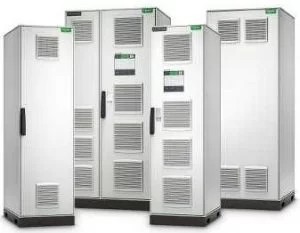
One of the most common questions we hear from facilities managers, data center engineers, and IT directors is: “Which Schneider Electric UPS is right for my application?” The Schneider Electric three-phase UPS portfolio is extensive — covering load ranges from 10 kVA to 1,500 kVA across multiple product families, each optimized for a specific combination of environment, scale, and availability requirement.
Unlike the single-phase APC Smart-UPS lineup, which is designed primarily for individual servers and network closets, Schneider Electric’s three-phase Galaxy series is built for enterprise data centers, mission-critical facilities, and demanding industrial environments where power infrastructure decisions have long-term capital and operational consequences. Choosing the wrong model can mean paying for features you don’t need — or under-specifying a system and compromising availability.
This guide walks through the key decision factors and maps them to the right Schneider Electric UPS family. Power Solutions, LLC is an APC Elite Partner with application experience across the complete Schneider Electric portfolio. If you’d like expert guidance for your specific situation, call us at 800-876-9373.
Step 1: Start with Load Size
Everything in UPS selection begins with load — the total power draw, in watts or kilowatts, of the equipment you need to protect. For three-phase UPS systems, load is typically expressed in kVA (kilovolt-amperes) or kW (kilowatts). If you have a power factor of 1.0 (unity), kVA and kW are equal. Most modern Schneider Electric Galaxy systems are rated at unity power factor, which simplifies the math.
Start by adding up the nameplate wattage or power draw of every piece of equipment the UPS will protect. Add a safety margin of 20–25% above your calculated load to allow for growth and to avoid running the UPS at or near capacity, which reduces efficiency and battery life. The resulting number is your minimum UPS capacity in kW.
Load sizing example:
A data center pod with 40 populated server racks drawing an average of 8 kW each = 320 kW total load. Adding a 25% growth margin: 320 × 1.25 = 400 kW minimum UPS capacity. This points to the Galaxy VX range (500–1,500 kVA at unity power factor).
Important note: always size based on actual measured load where possible, not nameplate ratings. Servers and networking equipment typically run well below their nameplate maximum. Nameplate-based sizing can lead to significant over-specification and unnecessary capital cost.
Step 2: Consider Your Environment
The Schneider Electric three-phase UPS lineup spans controlled data center environments, mixed commercial/industrial facilities, and hardened industrial sites. Where your UPS will be installed materially affects which product family is appropriate.
Controlled Data Center or IT Environment
If your UPS will be installed in a temperature and humidity-controlled data center, computer room, or network operations center, the Galaxy VS, VL, or VX is the right family. These are IT-grade systems designed for stable, monitored environments. They assume clean power input, regulated temperature, and professional installation by certified technicians.
Mixed Commercial / Facilities Environment
Buildings with a mix of IT loads, lighting, HVAC, and general electrical loads — hospitals, financial trading floors, campus buildings, broadcast facilities — typically require a UPS that handles somewhat dirtier power input and wider load variability. The Galaxy VS and VL both accommodate wider input voltage ranges and are well-suited for these environments. For facilities-level protection at the building distribution panel rather than at the rack level, the Galaxy VL and VX are commonly specified.
Industrial Environment
Dusty, warm, vibration-prone, or chemically active environments — manufacturing floors, process control rooms, substations, outdoor enclosures — are outside the design envelope of the Galaxy series. For these applications, Schneider Electric offers the Gutor PXC, which is purpose-built for harsh industrial conditions. Power Solutions can assist with industrial UPS applications; contact us to discuss your specific environment.
Step 3: Understand UPS Topology
All Schneider Electric Galaxy series UPS systems are double-conversion online UPS, meaning the connected load always runs from inverter-generated power. This provides zero transfer time to battery, complete electrical isolation from utility power problems, and the highest level of power conditioning available. This is the correct topology for data centers and any application where power quality is non-negotiable.
Within double-conversion topology, the key differentiator across the Galaxy series is operating mode flexibility. All Galaxy systems can operate in standard double-conversion mode. The Galaxy VS, VL, and VX also support ECOnversion mode — a patented Schneider Electric operating mode that allows the UPS to deliver up to 99% efficiency (vs. approximately 96–97% in standard double-conversion) by minimizing the active power conversion load under stable grid conditions while maintaining the ability to switch to full double-conversion within milliseconds if needed.
For most data center and critical facilities applications, ECOnversion mode provides an excellent balance of efficiency and protection. For environments with extremely poor power quality or where any deviation from perfect output waveform is unacceptable, operating in standard double-conversion mode at all times is the safer choice.
Step 4: Plan for Scalability and Redundancy
One of the most significant advantages of the Schneider Electric Galaxy series over traditional monolithic UPS systems is modular, scalable architecture. All three Galaxy families (VS, VL, VX) are designed to grow with your load and to support N+1 or higher redundancy configurations without replacing the entire system.
N+1 Redundancy
N+1 redundancy means the UPS system has one more power module than required to carry the load. If any single module fails, the remaining modules carry the full load without interruption. This is the standard configuration for Tier III equivalent data center environments. The Galaxy VS supports internal N+1 redundancy within a single cabinet. The Galaxy VL and VX support N+1 and higher redundancy through modular frame configurations.
Parallel Configurations
For larger facilities requiring very high availability or loads exceeding the capacity of a single frame, multiple Galaxy VL or VX units can be configured in parallel. Parallel configurations allow total system capacity well beyond the single-unit maximum and provide frame-level redundancy — if one UPS frame fails entirely, the others carry the load. This is the architecture used in Tier IV equivalent and hyperscale data center deployments.
Right-sizing vs. Future-proofing
A common mistake in three-phase UPS specification is over-sizing to accommodate theoretical future growth that never materializes. A UPS operating at 30–40% of its rated capacity runs less efficiently than one operating at 60–80% of rated capacity. The modular Galaxy architecture allows you to start with a system sized for today’s load and add capacity modules as load grows — avoiding both the efficiency penalty of over-sized systems and the risk of under-sizing.
Step 5: Choose Your Battery Chemistry
All Schneider Electric Galaxy series systems are available with both traditional VRLA (valve-regulated lead-acid) batteries and lithium-ion battery systems. The right choice depends on your runtime requirements, available footprint, budget, and service lifecycle preferences.
VRLA Batteries (Standard)
VRLA batteries are the proven, lower-upfront-cost option. They are appropriate for environments where initial capital cost is the primary constraint and where regular battery maintenance and replacement at 3–5 year intervals is operationally manageable. VRLA batteries are heavier and larger than lithium-ion equivalents, which is a relevant constraint in facilities with limited floor load capacity or tight physical footprints.
Lithium-Ion Batteries
Lithium-ion battery systems for the Galaxy VS, VL, and VX offer significantly longer service life (8–10 years vs. 3–5 years for VRLA), a substantially smaller and lighter form factor, faster recharge times after a discharge event, and built-in battery management systems that provide more accurate state-of-health monitoring and runtime prediction.
The total cost of ownership case for lithium-ion is strong in environments where battery replacement is logistically complex or costly — dense data centers where UPS access requires significant operational planning, remote or unmanned facilities, and any application where minimizing maintenance visits is a priority. Power Solutions has published a detailed lithium-ion vs. VRLA total cost of ownership analysis; contact us for a copy.
One important consideration: lithium-ion UPS systems have specific installation, ventilation, and fire suppression requirements. Your facility’s electrical contractor and fire suppression system should be reviewed before specifying lithium-ion batteries in any existing building.
The Schneider Electric Galaxy UPS Portfolio
Galaxy VS | Medium-Density Data Centers & Critical Facilities
Schneider Electric Galaxy VS 10–75 kVA (208V)/20–150 kVA (480V)
The Galaxy VS is Schneider Electric’s entry point into the three-phase Galaxy series and is the most commonly specified model for medium-sized data centers, server rooms, edge deployments, and critical facility environments. It is highly efficient, compact, and easy to deploy — making it well-suited for organizations that need enterprise-grade UPS protection without the footprint or complexity of larger systems. The Galaxy VS is a double-conversion online UPS with modular architecture, supporting N+1 internal redundancy within a single cabinet. It operates at up to 97% efficiency in standard double-conversion mode and up to 99% in ECOnversion mode.
Battery modules are integrated within the UPS cabinet, which optimizes floor footprint and eliminates the need for separate battery strings and cabling in smaller deployments. Both VRLA and lithium-ion battery options are available.
The Galaxy VS connects to Schneider Electric’s EcoStruxure IT platform for remote monitoring, DCIM integration, and predictive analytics. It includes a network management card slot and supports SNMP, Modbus, and BACnet communication protocols. The Galaxy VS is the right choice when your load falls in the 20–150 kVA range, you need a compact, efficient, easy-to-service system, you want internal N+1 redundancy without parallel frames, and you are operating in a temperature-controlled IT or facilities environment.
Galaxy VL | Large Data Centers & Enterprise Power Zones
Schneider Electric Galaxy VL 200–500 kVA/kW
The Galaxy VL is designed for large data centers and enterprise power zones where scalability, redundancy, and low total cost of ownership over a 10–15 year system lifecycle are the primary design criteria. It bridges the gap between the Galaxy VS and the large-scale Galaxy VX, occupying the 200–500 kVA range that covers the majority of enterprise data center deployments.
The Galaxy VL is a double-conversion online system with a modular frame architecture. It supports N+1 internal redundancy and can be configured in parallel with additional Galaxy VL units for frame-level redundancy or total capacity beyond 500 kVA. Like the Galaxy VS, it supports both ECOnversion and standard double-conversion operating modes, with up to 99% efficiency in ECOnversion mode.
The Galaxy VL is notable for its serviceability: it provides full front access, top and bottom cable entry, and a modular design that allows components to be replaced without de-energizing the system. This minimizes planned maintenance downtime and is particularly important in 24/7 data center operations where scheduled outages are costly to arrange. Both VRLA and lithium-ion battery configurations are supported. Lithium-ion is especially compelling at this scale — the battery maintenance interval reduction from 3–5 years (VRLA) to 8–10 years (lithium-ion) translates to meaningful operational savings over a typical 10-year system lifecycle.
The Galaxy VL is the right choice when your load falls in the 200–500 kVA range, you require a scalable system that can grow with your load, you are designing for N+1 or higher redundancy, and serviceability and total cost of ownership over the system lifetime are key evaluation criteria.
Galaxy VX|Large Enterprise Data Centers & Hyperscale Environments
Schneider Electric Galaxy VX 500–1,500 kVA/kW
The Galaxy VX is Schneider Electric’s flagship large-scale three-phase UPS and is designed for enterprise data centers, hyperscale deployments, large campus facilities, and any application where a single UPS system must protect substantial portions of an organization’s critical power infrastructure. It covers load ranges from 500 kVA to 1,500 kVA as a single unit and supports parallel configurations for even higher capacity or frame-level redundancy.
The Galaxy VX builds on the Galaxy VS and VL architecture with additional operating mode flexibility, including ultra-efficient ECOnversion mode at up to 99% efficiency, standard double-conversion mode, and a high-efficiency mode suitable for stable grid environments. It supports Schneider Electric’s EcoStruxure IT platform and provides comprehensive communication interfaces including touchscreen display, web interface, Modbus, BACnet, and integration with the StruxureWare Data Center Expert DCIM platform.
At this scale, the Galaxy VX is typically specified as part of a broader power infrastructure design that includes power distribution units, transfer switches, and generator integration. Power Solutions’ engineering team has experience designing and implementing complete power infrastructure solutions at this scale and can assist with site assessment, system design, equipment specification, and turnkey installation.
The Galaxy VX is the right choice when your load exceeds 500 kVA, you are building or expanding a large enterprise or colocation data center, you require parallel configuration for frame-level redundancy or total capacity beyond 1,500 kVA, and you need the highest level of efficiency and management capability available in the Schneider Electric portfolio.
Quick Reference: Which Galaxy UPS Is Right for You?
Load Range | Best Model | Key Use Case | Topology |
20–150 kVA | Galaxy VS | Medium data centers, edge, critical facilities | Double-conversion online |
200–500 kVA | Galaxy VL | Large enterprise data centers, power zones | Double-conversion online |
500–1,500 kVA | Galaxy VX | Large enterprise, colocation, hyperscale | Double-conversion online |
500 kVA+ | Galaxy VX (parallel) | Highest availability, frame redundancy | Parallel double-conversion |
Note: All Galaxy series models support both VRLA and lithium-ion battery options, ECOnversion high-efficiency mode, and EcoStruxure IT integration. Power factor is unity (1.0) across the Galaxy series, so kVA and kW ratings are equivalent.
A Note on End-of-Life Models
Schneider Electric regularly updates its UPS portfolio, and some previously popular models are no longer in production. If you have existing Schneider Electric UPS equipment that has reached or is approaching end-of-life, Power Solutions can assist with replacement planning.
The Schneider Electric Galaxy VM (160–1,000 kVA) reached end-of-life in September 2025. Customers with existing Galaxy VM installations should contact Power Solutions to discuss replacement options. Depending on your current load, runtime requirements, and available space, the Galaxy VL or Galaxy VX is typically the recommended replacement path. Power Solutions can assess your existing installation and manage the transition with minimal operational disruption.
When to Call Before You Specify
Three-phase UPS selection at the data center scale is a significant capital decision, and the right answer is rarely straightforward. Before finalizing a specification, consider engaging Power Solutions’ application engineering team if any of the following are true:
- Your load is at or near the boundary between Galaxy VS and VL (150–200 kVA range), where detailed load analysis may identify opportunities to stay within the VS range or confirm you need the VL.
- You are designing for redundancy and need help determining whether internal N+1 within the Galaxy VS or VL, or parallel frames, is the right architecture for your availability requirement.
- You are replacing an existing Galaxy VM or other end-of-life Schneider Electric system and need to assess whether your load, runtime, and facility constraints have changed since the original installation.
- You are evaluating lithium-ion vs. VRLA and need a total cost of ownership analysis specific to your load profile, maintenance schedule, and battery replacement logistics.
- You are integrating a new UPS with existing power distribution, generators, or transfer switches and need coordination across the full power chain.
- You are designing for a regulated environment (healthcare, government, financial services) with specific compliance requirements that affect UPS specification, installation standards, or documentation.
Download a whitepaper version of this article.