
BAA Compliant UPS Products from Schneider Electric: Ensuring Reliability, Compliance, and Cost Savings in Critical Power Protection
 The Buy American Act (BAA), enacted in 1933, mandates that products purchased by the U.S. federal government must be manufactured domestically to the greatest extent possible, fostering economic growth and national security. In the realm of uninterruptible power supplies (UPS), BAA compliance is paramount for government agencies, educational institutions, and state/local entities (SLED) procuring power protection solutions. Schneider Electric, through its APC brand, has long been a leader in delivering BAA-compliant UPS systems that safeguard mission-critical infrastructure against power disruptions. These products meet stringent domestic content requirements—typically 55% U.S.-manufactured components—while offering high efficiency, scalability, and integration with modern IT environments.
 Beyond compliance, purchasing BAA-compliant UPS equipment provides a strategic advantage in avoiding surcharges associated with import tariffs, which have escalated under recent trade policies. As of 2025, executive actions like the America First Trade Policy have imposed tariffs ranging from 10% to 50% on imports from key trading partners, including China, Mexico, Canada, and the EU, covering electronics components critical to UPS manufacturing. These duties, often compounded by carrier surcharges (e.g., $30–$80 per package for brokerage and forwarding fees from carriers), inflate costs for non-domestic products by up to 20% or more. By opting for BAA-compliant alternatives, agencies sidestep these direct and indirect expenses, as domestically assembled units bypass import duties entirely, stabilizing budgets and enhancing long-term total cost of ownership (TCO). This essay discusses available models, highlights introductions in 2025 emphasizing lithium-ion battery advancements and explores planned enhancements for 2026 and beyond. By prioritizing sustainability, modularity, and edge computing compatibility, these solutions align with federal mandates like the Infrastructure Investment and Jobs Act, which reinforces BAA through the Build America, Buy America (BABA) provisions.
Current BAA-Compliant UPS Models: The Smart-UPS On-Line Series
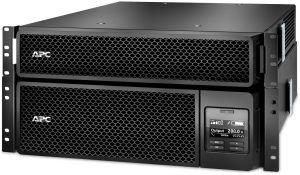
Schneider Electric’s flagship BAA-compliant offerings are within the APC Smart-UPS On-Line series, designed for distributed IT, edge deployments, and small-to-medium data centers. These rack-mountable units deliver pure sine wave output, zero transfer time, and extended runtime options, ensuring seamless operation during outages. Models are identifiable by suffixes like “-AUS” or “-A,” denoting BAA adherence, and are manufactured in U.S. facilities to comply with federal procurement standards. Selecting these over imported equivalents not only fulfills BAA but also mitigates tariff-related surcharges, as foreign UPS components—such as inverters and batteries—face duties up to 35%, which manufacturers often pass downstream, eroding procurement savings.
Key available models include:
- SRT2200RMXLAUS (2.2 kVA/1.98 kW): A 2U rack/tower convertible UPS ideal for entry-level server rooms. It supports up to four external battery packs for runtime extension up to hours, with network-grade power conditioning to protect against surges and harmonics. Priced for affordability, it suits organizations requiring compact, reliable protection.
- SRT3000XLAUS (3 kVA/2.7 kW): This 3U model extends capacity for growing edge environments, featuring swappable hot-plug batteries and EcoMode for up to 98% efficiency. Its LCD interface enables intuitive monitoring, making it suitable for agencies managing remote IT assets.
- SRT5KRMXLT-5KTF-A (5 kVA/4.5 kW): A 3U rack unit with extended runtime via integrated battery modules, offering N+1 redundancy. It includes SmartSlot for environmental sensors and integrates with Schneider’s EcoStruxure IT platform for predictive maintenance, reducing downtime in critical networks.
- SRT8KRMXLT-A (8 kVA/8 kW): Scaling to 6U, this model handles mid-sized deployments with 208V input/output and multiple outlet configurations (e.g., L6-20R, L6-30R). Its 96% efficiency in double-conversion mode minimizes energy costs, aligning with sustainability goals.
- SRT10KRMXLT-A (10 kVA/10 kW): The series’ high-end current offering in 6U form factor, supporting up to 10 external battery packs for prolonged backup. With advanced cybersecurity features like user authentication, it protects sensitive data in critical applications.
These models exclude lead-acid variants phased out for environmental reasons, focusing instead on scalable, user-replaceable designs. All incorporate Green Mode for reduced operational expenses and comply with ENERGY STAR standards, contributing to lower TCO in BAA-restricted bids.
Innovations Introduced in 2025: Lithium-Ion Advancements
In 2025, Schneider Electric expanded its BAA-compliant portfolio with lithium-ion (Li-ion) battery integrations across the Smart-UPS On-Line line, addressing the demand for longer life cycles and faster recharge times in high-availability environments. Li-ion batteries offer 2-3 times the lifespan of traditional VRLA (valve-regulated lead-acid) options, reducing replacement frequency by up to 70% and enhancing sustainability—a key federal priority. These advancements are particularly valuable amid tariff pressures, as imported Li-ion cells from Asia incur 25–50% duties, enabling BAA models to deliver premium performance without the premium pricing of tariff-laden imports.
Notable 2025 introductions include enhanced Li-ion variants of the SRT series, such as the SRT5KRMXLI-A (5 kVA Li-ion model) and SRT10KRMXLI-A (10 kVA Li-ion model). These rack-optimized units maintain the core double-conversion architecture but incorporate LFP (lithium iron phosphate) chemistry for safety and thermal stability, supporting densities up to 30 kW in modular configurations. Launched mid-2025, they feature intelligent battery management systems (IBMS) that predict end-of-life with 99% accuracy, integrating seamlessly with Schneider’s AVANTSS predictive analytics for proactive alerts.
Additionally, the Smart-UPS Ultra and Modular Ultra series received BAA certification updates in 2025, with models like SMX5KULI-A (5 kW modular Li-ion) and SRT10KRMXLT-A Ultra (10 kW modular Li-ion) now offering hot-swappable power modules and internal redundancy. This evolution targets micro data centers in government facilities, where space constraints demand ultra-high density (up to 10 kW in 2U). These introductions reflect Schneider’s $700 million U.S. investment commitment through 2027, bolstering domestic manufacturing in states like Texas and South Carolina.
These 2025 models not only meet BAA thresholds but exceed them, with over 60% domestic content, enabling faster procurement under GSA schedules.
Planned Developments for 2026 and Beyond: Scalability and Hybrid Integration
Looking ahead, Schneider Electric plans to further innovate its BAA-compliant UPS lineup for 2026, emphasizing modularity, AI-ready features, and hybrid AC/DC architectures to support emerging federal initiatives like zero-trust security and net-zero emissions. While specific model announcements are forthcoming, industry roadmaps indicate expansions in the Smart-UPS ecosystem, including higher-capacity Li-ion modules up to 15 kVA and integrated DC fast-charge options for edge AI workloads. Future designs will prioritize even higher domestic sourcing to further insulate against evolving tariffs, such as the 40% penalties on transshipped goods aimed at evasion.
Anticipated for Q1 2026 is the Smart-UPS On-Line Extended Series (SRT15KRMXLT-A), a 15 kVA model with enhanced paralleling capabilities for up to 80 kVA scalability. This will incorporate gallium nitride (GaN) inverters for 99% efficiency, reducing cooling needs in hyperscale government clouds. Building on 2025’s Li-ion push, these units will feature standardized battery packs compatible across voltages (120V to 208V), simplifying fleet management for multi-site agencies.
Beyond 2026, Schneider envisions hybrid UPS solutions blending online topology with renewable integration, such as solar-compatible models under the Galaxy VS lineage adapted for BAA. These will target large-scale deployments in DoD facilities, with projected domestic content exceeding 70% through expanded U.S. supply chains. Early prototypes, teased in 2025 sustainability reports, promise 30% TCO reductions via AI-optimized load balancing.
These plans underscore Schneider Electric’s alignment with BABA expansions, ensuring UPS systems evolve with federal electrification goals.
Conclusion
Schneider Electric’s BAA-compliant UPS products, anchored by the versatile Smart-UPS On-Line series, provide robust, domestically produced power assurance for public sector needs—while shielding budgets from tariff surcharges that burden imported alternatives. The 2025 lithium-ion introductions mark a pivotal shift toward greener, more resilient designs, while 2026’s modular advancements promise even greater scalability. By excluding outdated models and investing in U.S. innovation, Schneider Electric not only fulfills compliance but empowers agencies to build secure, sustainable infrastructures free from trade volatility. As power demands intensify with AI and 5G, these solutions will remain indispensable, bridging policy with performance for a resilient American digital landscape.
For more information or assistance selecting a BAA Compliant UPS, call 800-876-9373, or email [email protected].