
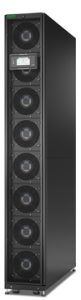
 A 2026 Planning Guide: What’s Changing, the Affected InRow Equipment, and the Replacement Path
By Molly Gross, principal, Power Solutions LLC
For most data center operators, refrigerant has been a quiet specification. It sits inside the cooling system, doesn’t affect day-to-day operations, and gets touched only during installation, scheduled maintenance, or service. That changes in 2026. New U.S. regulations are limiting the global warming potential (GWP) of refrigerants used in new data center HVAC equipment, and several Schneider Electric InRow products that use R410A refrigerant are being withdrawn from the North American market on a defined timeline.
This article is for IT directors, facilities managers, engineers, and MEP contractors evaluating InRow cooling refresh, retrofit, or expansion in 2026 and beyond. It covers the regulatory framework driving the change, the specific InRow models being withdrawn, the transition timeline, the new replacement products that are now available, and the operational considerations that go into planning the replacement.
The Regulatory Framework
The American Innovation and Manufacturing (AIM) Act, passed by Congress in 2020 gives the U.S. Environmental Protection Agency (EPA) authority to phase down the production and use of hydrofluorocarbon (HFC) refrigerants based on their global warming potential. Under that authority, the EPA’s Technology Transitions Rule sets specific GWP limits by equipment category and application.
For new air conditioning systems used in data centers, the rule sets a GWP limit of 700, effective January 1, 2027. After that date, new installations of equipment using refrigerants above the 700 GWP threshold are prohibited.
R410A — the dominant refrigerant in the previous generation of direct-expansion data center cooling equipment — has a GWP of 2,088 under the AR4 values that the EPA uses for regulatory compliance. That is roughly three times the new limit. As a result, equipment using R410A is being phased out of the new-installation market, and manufacturers are transitioning their product lines to lower-GWP alternatives. The two leading replacement refrigerants in HVAC applications are R32 (GWP 675) and R454B (GWP 466) — both single-component or near-azeotropic A2L refrigerants well below the 700 threshold.
What This Means for Installed Equipment vs. New Installations
The Technology Transitions Rule applies to the installation of new equipment. Equipment that is already installed and operating can continue to do so, and existing R410A refrigerant supplies remain available for service and maintenance. The regulatory pressure is at the point of new equipment specification and installation:
- Installations of new R410A-based equipment must be complete before January 1, 2027.
- After that date, new installations using refrigerants above the 700 GWP threshold are prohibited under federal regulation.
- Equipment installed before the deadline can continue to operate, with manufacturer service support continuing through commitments made at installation.
For organizations planning a cooling refresh, expansion, or retrofit in 2026, this means the path forward depends on installation timing. Equipment installed in 2026 can still be R410A-based if the manufacturer continues to make it available. Equipment installed in 2027 or later must use a refrigerant below the 700 GWP threshold.
Schneider Electric’s R410A InRow Withdrawal
Schneider Electric is transitioning its InRow product line to align with the new GWP limits. As part of that transition, the following R410A-based InRow models are being withdrawn from the North American market:
- ACRD200 series
- ACRD300 series
- ACRD600 series
- ACRH300 series
The withdrawal follows a defined timeline that has direct implications for organizations considering specifying these models in 2026 projects. The May 31, 2026 order cutoff is the binding date for new procurement of the affected models.
Transition Timeline
Date | Milestone |
April 30, 2026 | Made-to-order (MTO) status transition. As inventory depletes, lead times extend. |
May 31, 2026 | Final date to place new orders for the affected R410A InRow models. |
Early August 2026 | Final production and shipment from the India Cooling Factory to the North American distribution center. |
October 16, 2026 | Recommended last delivery date from distribution to customer site, to allow time for installation and commissioning. |
December 31, 2026 | All units must be installed, commissioned, and operational before this date. |
January 1, 2027 | New installations of R410A-based equipment prohibited under the EPA Technology Transitions Rule. |
Replacement Equipment: New Schneider Electric InRow Products
Schneider Electric launched two next-generation InRow products on April 3, 2026, both designed around lower-GWP refrigerant requirements and current data center cooling priorities including AI and high-performance compute environments.
InRow ACRC331 — 40kW Chilled Water (300mm)
The ACRC331 replaces the ACRC301H. It is designed for medium- to high-density applications including AI and HPC environments. Because it operates as a chilled water unit, the refrigerant question is decoupled from the unit itself and addressed at the chiller plant level — which gives operators flexibility on how and when to address refrigerant transitions in their plant infrastructure.
Key features of the ACRC331:
- 9% higher cooling capacity than the ACRC301H across a wide range of water temperatures.
- Pressure-independent control valve reduces operating costs. Traditional 3-way valve with shutoff also available.
- Ultra-efficient adiabatic humidifier — Title 24 compliant for California and Washington — operating at 100–120V or 200–240V single-phase.
- P-model configuration with reheat and electrode humidifier — available for the first time in a 300mm chilled water unit.
- Manages condensate without a dewpoint control pump for simpler operation.
- Integrated ATS supports redundant power feeds while reducing site infrastructure cost.
InRow ACRD101S/P — 11kW Air-Cooled (300mm)
The ACRD101S/P replaces the ACRD100 (R410A). It is designed for low- to medium-density applications including network closets, edge locations, and small to medium data centers. It uses R32 refrigerant — a single-component HFC with a GWP of 675, below the 700 GWP regulatory threshold.
Key features of the ACRD101S/P:
- Low-GWP R32 refrigerant — compliant with current EPA environmental regulations.
- 10% higher cooling capacity than the ACRD100 (R410A).
- P-model configuration with reheat and electrode humidifier — available for the first time in the RD100 series.
- Wide capacity modulation — stable operation from 3.0 kW to 11.0 kW.
- Longest piping capability in its class — up to 120m runs with 30m vertical lift.
- Reliable year-round operation from –40°F to 115°F outdoor temperature.
- Optional dual-input power ATS for improved system availability.
Choosing Between Chilled Water and Air-Cooled InRow for the Replacement
For organizations replacing R410A InRow equipment, the choice between chilled water (ACRC331) and air-cooled DX (ACRD101S/P) depends on existing infrastructure, density profile, and application. The two replacement products serve different deployments and represent different infrastructure investments.
Chilled Water (ACRC331) is appropriate when
- The facility already has a chiller plant with available capacity or is planning chiller plant expansion.
- The cooling load is in the medium- to high-density range that benefits from 40kW per-unit capacity.
- Multiple InRow units are deployed in the same room and plant-level efficiency is a meaningful operational priority.
- AI and HPC workloads are part of the load profile, where higher density and tight temperature control matter.
- The refrigerant transition is best handled at the plant level rather than per-unit — plant-level refrigerant changes can be managed independently of room-level cooling deployments.
Air-Cooled DX (ACRD101S/P) is appropriate when
- The facility does not have a chiller plant, or installing one is not justified by the load.
- The cooling load is in the low- to medium-density range, with single units or small numbers of units serving network closets, IDF rooms, or small server rooms.
- Edge or remote locations require self-contained cooling without dependency on a central plant.
- Long refrigerant line runs are required — the ACRD101S/P supports up to 120m piping with 30m vertical lift, which addresses many constrained installation geometries.
- Wide outdoor temperature operation is required, particularly for facilities in regions with significant seasonal variation.
Hybrid Considerations
In some facilities the right answer is a mix. Larger central rooms transition to chilled water with ACRC331 units, while distributed network closets and remote rooms continue with air-cooled DX using ACRD101S/P. The replacement plan should follow the existing infrastructure logic rather than force a single architecture across the entire facility. For organizations evaluating both options across multiple locations, a basis-of-design conversation early in the planning process is usually worth the time.
What the Replacement Project Actually Involves
For organizations planning the transition, it is worth being clear-eyed about what a replacement project involves. This is not a refrigerant swap or a like-for-like unit change. The scope of work — and the realistic installation timeline — varies significantly depending on the transition path.
Scenario 1: R410A InRow DX to R32 InRow DX (e.g., ACRD100 to ACRD101S/P)
This is the path with the most installation work, and it is the path where the most planning mistakes get made. The replacement requires a new indoor unit, a new outdoor condenser, and — in most cases — new refrigerant line sets between them. The unit itself is a full replacement: R32 systems are purpose-built, with different pressure characteristics, oil return behavior, control logic, and safety provisions than R410A systems. Schneider Electric and the broader HVAC industry have been consistent that R32 systems are not retrofits of R410A equipment — the system must be R32-rated end to end.
The question most customers ask is whether the existing refrigerant line set between the indoor unit and the outdoor condenser can be reused. In practice, for most installations, the answer is no — and planning to replace the lines is the realistic default.
Several factors make line reuse difficult or impractical in real-world installations:
- POE oil contamination. R410A systems use polyolester (POE) oil that becomes embedded in line set walls over years of operation. Residual oil contaminates the new R32 charge, degrading performance, reducing capacity, and reducing reliability. Effective cleaning requires solvent flushing, multiple evacuations, and verification — work that is frequently comparable in cost and time to running new lines.
- Line sizing differences. R32 generally requires different line diameters than R410A for optimal performance. Reusing R410A piping can result in capacity loss, efficiency penalty, or excessive pressure drop, even if the lines are clean.
- Code compliance for A2L refrigerants. Under the 2021 International Mechanical Code, refrigerant piping for A2L systems that penetrates two or more floor or ceiling assemblies must be enclosed within a fire-resistance-rated shaft, with ventilation provisions. Existing R410A line runs frequently were not installed under these requirements and don’t meet them. Bringing legacy piping into compliance is often more disruptive than running new lines through compliant routes.
- Liability and certification. Modifying an R410A line set for R32 service places the installing contractor in the position of designer of record for safety compliance — including AHJ acceptance, leak detection requirements, and charge limit verification per ASHRAE 15. Most reputable contractors will not take on that liability for reused piping.
The cases where line reuse genuinely makes sense — recent piping installation, well-documented line runs in non-restrictive locations, and a contractor willing to certify compliance — are the exception, not the norm. For project planning purposes, the realistic assumption is that new refrigerant lines will be part of the scope.
Other elements of the Scenario 1 project scope:
- Outdoor unit replacement. The existing R410A condenser is not compatible with R32 and must be replaced.
- A2L-compliant leak detection per code, where applicable to the installation.
- Electrical scope review. The new ATS option in the ACRD101S/P may change feed requirements; some installations will require an additional circuit or feeder.
- Permit and AHJ engagement for A2L installation in occupied spaces, particularly for installations that fall under updated mechanical and fire code provisions.
- Technician certification. A2L servicing requires updated training and A2L-compatible service tools — non-sparking recovery machines, A2L-rated vacuum pumps, and similar.
Scenario 2: Chilled Water to Chilled Water (ACRC301H to ACRC331)
This is the simplest transition. Chilled water piping carries water or glycol, not refrigerant, so the regulatory transition does not drive piping changes between the unit and the chiller plant. Existing CHW piping is typically reusable with proper inspection, flushing, and any necessary water treatment.
The work scope is comparable to a routine unit replacement:
- New cabinet, with site verification of footprint and mounting against existing infrastructure.
- New control valve. The ACRC331 ships with a pressure-independent control valve; the existing 3-way valve and tie-in may need to be updated.
- Updated controls and EcoStruxure IT integration.
- Possible simplification of condensate handling — the ACRC331 does not require a dewpoint control pump.
- Electrical scope review for the integrated ATS option.
Scenario 3: Cross-Architecture — R410A DX to Chilled Water
For organizations with no chilled water plant who need to replace larger DX capacity, the path to chilled water is a project, not a swap. It requires either existing chiller plant capacity that can absorb the new load, or investment in a chiller plant to support the new deployment. New chilled water piping must be run; existing refrigerant infrastructure is removed or abandoned in place. Engineering, permitting, and construction timelines for this scope typically run multiple months — meaningfully longer than the timeline implied by the December 31, 2026 regulatory deadline if planning hasn’t already started.
A Note on Capacity Matching for the Larger R410A InRow Models
Schneider Electric’s first low-GWP InRow product launched in April 2026 — the 11kW ACRD101S/P. Additional models are confirmed to be rolling out in phased portfolio transitions. However, as of mid-2026, there is no publicly announced like-for-like R32 successor for the larger R410A DX units, including the ACRD200, ACRD300, ACRD600, and ACRH300 families. For organizations operating those units, the current replacement options are:
- Wait for an announced R32 successor in the appropriate capacity range. This carries risk against the December 31, 2026 installation deadline if launch timing slips.
- Transition to chilled water using the ACRC331 (40kW per unit), where chiller plant infrastructure supports it or where it can be added.
- Deploy multiple smaller R32 units (ACRD101S/P at 11kW each) in place of a single larger R410A unit, where space, electrical, and refrigerant line configurations allow.
For organizations operating ACRD200, ACRD300, ACRD600, or ACRH300 units, an early conversation with your Power Solutions, LLC specialist is warranted. Replacement product roadmaps may be available that aren’t yet on public-facing pages, and the right path for a specific facility depends on existing infrastructure, capacity requirements, and the binding deadlines for your installation.
Planning the Replacement Timeline
For organizations operating any of the affected R410A InRow models, replacement planning has three operational phases in 2026.
Phase 1: Inventory and Assessment (immediate)
Identify all installed R410A InRow units across the facility — central data center rooms, IDF closets, edge locations, and remote sites. The affected models include the ACRD200, ACRD300, ACRD600, and ACRH300 series. Confirm model numbers from physical equipment labels, EcoStruxure IT inventory records, or service contract documentation. Document service plan status, equipment age, and current operational condition. This inventory establishes which units have a regulatory replacement clock and which do not.
Phase 2: Replacement Specification (April–May 2026)
For units identified for replacement, specify the right replacement equipment based on density, infrastructure, and application. The decision between chilled water (ACRC331) and air-cooled DX (ACRD101S/P) should follow the framework in the previous section. Engineers and MEP contractors involved in the project may benefit from a basis-of-design discussion at this stage, particularly for facilities where the replacement involves a transition from one architecture to another.
For organizations planning to procure additional R410A units before the cutoff — for example, to complete a phased project that began with R410A equipment — the May 31, 2026 order date is the binding constraint. After May 31, the only path forward is the new replacement products.
Phase 3: Installation and Commissioning (June–December 2026)
R410A units ordered before the May 31 cutoff must be installed, commissioned, and operational before December 31, 2026. The recommended last delivery date from distribution to customer site is October 16, 2026, which provides approximately ten weeks for installation, electrical and mechanical integration, and commissioning. Replacement equipment using R32 (ACRD101S/P) and chilled water (ACRC331) does not face the same regulatory deadline. Installation of these units can continue past December 31, 2026 without restriction.
Operational Considerations Beyond the Refrigerant
The transition from R410A to lower-GWP InRow equipment is, on its face, a refrigerant change. In practice, it is also an opportunity to address other dimensions of cooling reliability that often get deferred when equipment has been operating without obvious issues. These dimensions include:
- Cooling redundancy. N+1 cooling capacity at the row or room level means that a single unit failure does not push remaining capacity below the load. The other units carry the room while the failed unit is serviced. The new ACRC331 and ACRD101S/P units are designed to support this kind of integration in modern rack-density and AI-influenced environments.
- Service plan coverage. New equipment is eligible for current factory service plans, including preventive maintenance, priority parts availability, and contractual response-time commitments. EcoStruxure IT remote monitoring extends visibility into temperature trends, status, and predictive alerts — addressing a common gap in installations where cooling has been monitored only at the room level rather than the unit level.
- Power feed redundancy. Both new units offer integrated or optional ATS for redundant power feeds, addressing a single-point-of-failure that has historically existed in single-feed cooling deployments. For environments where the cooling system is itself part of the critical infrastructure, dual-feed cooling is increasingly the right specification.
- Capacity for future load growth. AI workloads and continued IT consolidation mean that load profiles in 2026 are not the load profiles of 2018, when many installed units were originally specified. The replacement is an opportunity to right-size capacity against current and projected loads, rather than replicating the existing footprint without revisiting the assumptions.
Summary
The R410A refrigerant transition is a regulatory event with specific dates and specific products affected. For organizations operating Schneider Electric InRow cooling equipment using R410A — including the ACRD200, ACRD300, ACRD600, and ACRH300 series — the binding action dates are May 31, 2026 for any new orders of R410A units, and December 31, 2026 for installation completion. After January 1, 2027, new R410A InRow installations are prohibited under EPA regulation.
The replacement products — the ACRC331 chilled water unit and the ACRD101S/P air-cooled unit — are available now. Both are designed around the new low-GWP refrigerant requirements and incorporate features that align with current data center cooling priorities, including AI and high-performance compute environments. The right replacement decision depends on existing chiller plant infrastructure, density profile, and the specific application of the equipment being replaced.
Power Solutions supports organizations through every phase of the transition: equipment inventory and assessment, replacement specification and quoting, installation planning against the regulatory deadlines, and ongoing factory service plan coverage for the new InRow products.
Power Solutions provides UPS and cooling selection support, inventory and EOL assessments, specification and submittal support for replacement equipment, installation planning against the December 31, 2026 deadline, and authorized factory service plan coverage for the new InRow product line.
Call 800-876-9373 to discuss your facility, or visit our InRow cooling resource page to learn more.
Molly Gross, Principal at Power Solutions, LLC, has over 15 years of experience in critical power for enterprise and government applications. She has extensive knowledge of UPS and data center infrastructure with a specialization in services and product lifecycle management. Molly closely follows emerging trends and innovations in the critical power industry with an eye for incorporating leading edge technologies into both new construction and legacy infrastructures. Connect with Molly on LinkedIn.