
By Molly Gross, Principal, Power Solutions, LLC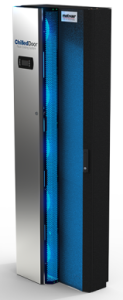
Most legacy data centers were designed around racks that drew a fraction of the power a single GPU server now requires. The cooling that serves them, whether CRAC or CRAH units on a raised floor, hot and cold aisle layouts, containment, or in-row coolers, was sized and arranged for that earlier load. As AI and high-performance workloads move into these rooms, the results are predictable: hot spots at individual racks, cooling equipment working at its limit, and facilities teams weighing a costly rebuild.
A rebuild is not the only answer. Retrofit options now exist that remove heat at the rack or at the chip rather than conditioning the whole room, and they can be added to existing racks without redesigning the facility. This article is written for IT directors and facilities managers evaluating those options. It covers how each approach works, where it fits, and what to confirm before choosing, with a focus on the Motivair ChilledDoor® by Schneider Electric rear door heat exchanger and Coolant Distribution Units (CDUs).
Why Room-Level Cooling Stops Keeping Up
Room-level cooling delivers cold air to the space and relies on airflow management to get it to the equipment that needs it. That approach works while rack densities are modest and fairly uniform. As densities climb, individual racks call for more cold air than the room’s distribution can deliver to them, and the cooling units compensate by running colder and harder. A room can show adequate total cooling capacity on paper while specific racks still run hot, because the airflow and supply air temperature at each rack, not total tonnage, determine what that rack receives.
Motivair makes the same observation in its product literature: methods such as CRAC and CRAH units, containment, hot and cold aisles, and in-row systems become less appealing as densities increase.
Retrofit constraints compound the problem. Existing facilities have fixed floor space, limited structural capacity, and chilled water or electrical infrastructure sized for a different load, and many cannot tolerate extended downtime. Any retrofit option has to be judged against those limits as much as against its cooling capacity.
The Retrofit Options at a Glance
Four approaches cover most legacy retrofit scenarios. They are not mutually exclusive, and many facilities combine them.
Approach | Where heat is removed | Typically fits | Key considerations |
Add or upgrade room-level air cooling (CRAC, CRAH, in-row) | In the room or row, after the heat has left the rack | Moderate density increases in rooms with spare cooling capacity and good airflow management | Effectiveness falls as rack density rises; each rack is limited by the air that can be delivered to it |
Passive rear door heat exchanger | At the rear of the rack, using the servers’ own fans to move air through the coil | Racks with moderate density where chilled water is available | Depends on server fan airflow; no fans of its own to adjust to changing load |
Active rear door heat exchanger (Motivair ChilledDoor) | At the rear of the rack, with its own EC fans and controls | Hot spots, rack-by-rack upgrades, and high-density rows, up to 75 kW per rack depending on model | Requires chilled water; adds depth to the rear of the rack |
Direct-to-chip liquid cooling with a CDU | At the processor, with a CDU managing the liquid loop | The densest GPU and high-performance computing loads | Requires a CDU and liquid-ready servers; usually paired with rear doors or room cooling for the remaining heat |
Motivair ChilledDoor: Active Rear Door Heat Exchanger
The ChilledDoor is an active heat exchanger that mounts directly to the rear of a standard or OEM server rack. Room air is pulled into the cabinet by the door’s EC fans, picks up heat as it passes through the servers, and then moves through the door’s heat exchanger, where the heat transfers to chilled water. The door returns cooled air to the room at a set point. Because the heat is removed at the rack, Motivair describes the result as a heat neutral white space: the heat the servers generate is neutralized before it leaves the cabinet.
The door monitors server air temperature or pressure, ambient room temperature, entering water temperature, and leaving air temperature, and adjusts to changing conditions at the rack. It operates above the dew point, which eliminates the possibility of condensation near critical electrical equipment.
Where the ChilledDoor fits
- Hot spots. Individual racks running hotter than the rest of the room can be treated without changing room-level cooling.
- Efficiency upgrades. Because doors are deployed rack by rack, a facility can add cooling capacity as density grows.
- Complete rooms. Motivair also designs ChilledDoors for every-rack or every-other-rack configurations. Motivair asks that every-other-rack designs be reviewed with them.
- New or existing racks. The door is designed to fit any industry standard server rack and is Open19 and OCP compliant.
What to know about the product
- Nine models, M4 through M16, with nominal capacities from 12 kW to 75 kW per rack, rated at 35% relative humidity, 75°F room temperature, and 55 to 65°F supply water.
- Hot-swappable EC fans with individual fan-fail sensing for quick replacement.
- Leak prevention and detection as standard, PLC controls with a local display, optional network remote monitoring and control, and optional dual A/B power.
- Single-phase 208V or 230V supply on all models.
- ETL, CSA, and CE certified, and made in the USA.
- Optional factory certified services: installation, start-up, commissioning support, warranty, and preventive maintenance.
Motivair CDU: Separating Building Water From the IT Cooling Loop
A Coolant Distribution Unit isolates the IT cooling loop from the facility’s chilled water supply. It controls the temperature and flow of clean, cool fluid delivered to IT cooling systems, including active and passive rear door heat exchangers and direct-to-chip liquid cooling, and it holds the secondary loop above the dew point to eliminate the possibility of condensation. Heat from the secondary loop transfers to the primary building loop through a stainless steel heat exchanger, and the primary supply can be a chiller, a cooling tower, or another natural resource. A CDU does not supply chilled water itself. It requires a primary chilled water source, so a site without one needs a source in place before either a CDU or a ChilledDoor can be installed.
Redundant pumps with variable speed drives, a modulating control valve that adjusts capacity to IT demand, and a PLC with adjustable temperature set points, dew point control, and alarm thresholds manage the unit. Remote communication is available over BACnet, Modbus, and SNMP, depending on the model.
Models span in-rack units that install in a standard 19-inch rack enclosure, at roughly 100 kW for the 4U model and about 200 kW for the MCDU-10, to floor-mounted units sized from several hundred kilowatts into the megawatt range. Rated capacities depend on supply temperatures, fluids, and application, so project conditions should be confirmed against Motivair’s technical specifications.
When a CDU is the right addition
- Direct-to-chip liquid cooling is planned or likely as densities continue to rise.
- Facility chilled water runs colder than the IT loop should, so the loop must be controlled above the dew point.
- The IT loop needs to be isolated from building water.
- Several rear doors or liquid-cooled racks are to be served from a single controlled loop.
Retrofit Planning: What to Confirm First
Most retrofit selections are settled by a handful of site facts. Confirming them early prevents a product choice that the building cannot support.
- Measured rack load. Size against the actual draw of each rack rather than nameplate ratings. Measured data shows which racks are true hot spots and which are not.
- Chilled water. Both products require a chilled water source. Confirm availability, supply temperature, capacity, and the piping route to the rack or row.
- Rack and aisle fit. A rear door adds depth to the back of the rack and swings open, with the ChilledDoor opening through 95 degrees. Confirm aisle clearance and rack compatibility against the model dimensions.
- Electrical supply. The ChilledDoor runs on single-phase power, while floor-mounted CDUs use three-phase supply. Confirm what is available near the location.
- Water management. Leak detection is standard on the ChilledDoor and standard or optional on CDUs, depending on the model. Confirm piping routes, shutoff provisions, and the response plan for the room.
- Monitoring and integration. Decide whether alarms and status should reach the building management system or an infrastructure monitoring platform, and confirm the communication protocol required.
- Installation and service. Factory certified installation, start-up, commissioning support, and preventive maintenance are available as options.
Cooling and Sustainability
Cooling is a major share of a data center’s energy use, and room-level cooling can spend part of that energy conditioning air that never reaches a hot rack. Removing heat at the rack concentrates the effort where the heat is produced. Motivair states that because the ChilledDoor works in tandem with the IT equipment’s own fans, fan power consumption and internal operating temperature decrease, which supports energy savings and longer equipment life.
Rack-by-rack deployment also lets cooling capacity follow actual load instead of being sized for a projected peak, so a facility avoids committing to capacity before it is needed. For organizations with energy or sustainability targets, that makes a staged retrofit easier to justify than a full cooling rebuild.
Choosing an Approach: A Framework
The following reflects how most retrofit decisions are made once the site facts above are known.
- Isolated hot spots in an otherwise adequate room: ChilledDoors on the affected racks, leaving room-level cooling as it is.
- Rising density across a row or a room, with chilled water available: ChilledDoors rack by rack, or across every rack or every other rack with Motivair’s review.
- Direct-to-chip liquid cooling planned, or mixed liquid and air cooling: a CDU to manage the liquid loop, combined with rear doors or room cooling for the remaining heat.
- No chilled water available: a conversation about options before any product is specified, since chilled water is a prerequisite for both products.
In most cases, measuring actual rack load and confirming the chilled water situation narrows the choice quickly. The remaining decisions, such as door sizing, CDU capacity, and monitoring integration, are specification work that is easier with the site data in hand.
Power Solutions can help you evaluate Motivair ChilledDoor and CDU options for your environment.
Call us at 800-876-9373 to discuss your rack densities and chilled water situation, or visit our Motivair ChilledDoor and CDU cooling pages to learn more