
 By Molly Gross, Principal, Power Solutions, LLC
The Problem With VRLA
Valve-regulated lead-acid batteries are the most widely deployed UPS battery technology — and the most common source of UPS failure. Not because they stop working suddenly, but because they degrade gradually and invisibly. A VRLA string that passes a routine voltage check can still have lost 30–40% of its rated runtime capacity. The only way to really know how much runtime you have is a discharge test under load. Most organizations don’t test as frequently as manufacturers recommend, which means the gap between what the nameplate says and what the battery can deliver grows undetected until there’s an actual utility event.
What Li-ion Changes
Lithium-ion batteries address the core problem directly. The integrated battery management system (BMS) monitors every cell continuously — voltage, temperature, state of charge, and state of health — in real time. State of health and remaining runtime are tracked continuously from cell-level measurements, so you no longer have to rely on periodic discharge testing to know battery condition. There’s no need for periodic discharge testing because the BMS tracks health between events, not just at test intervals. If a cell is degrading, EcoStruxure IT surfaces it before it becomes a failure.
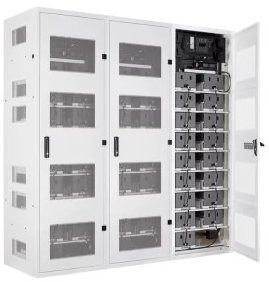
The service life difference compounds the operational advantage: about 10 years for Li-Ion versus 3–5 for VRLA. Over a typical 10-year UPS lifecycle, that typically means two to three battery replacements are avoided. The footprint reduction is also real: Li-Ion battery cabinets run approximately 30–50% smaller and about 60% lighter than equivalent VRLA configurations.
The upfront cost of Li-Ion is higher. The total cost of ownership, when the analysis includes avoided replacement cycles, reduced maintenance burden, and floor space freed for productive use, typically favors Li-Ion over a 10-year horizon. Power Solutions has published a detailed TCO analysis that walks through the numbers.
Where It Applies
Li-Ion battery options are available across the full Schneider Electric single-phase and three-phase UPS portfolio:
- Smart-UPS Ultra — compact single-phase rack and tower UPS for smaller server rooms, IDF closets, and edge locations
- Smart-UPS Modular Ultra (5–20 kW) — hot-swap modular single-phase UPS with N+1 redundancy for distributed IT rooms
- Galaxy VS, VL & VX (10–1,500 kVA) — three-phase systems for data centers and critical facilities at any scale
Li-Ion vs. VRLA — Key Differences
- Service life: About 10 years vs. 3–5 for VRLA
- Footprint: up to 30-50% smaller and 60% lighter
- Integrated BMS: continuous cell monitoring and state-of-health reporting
- Recharge: to 90% in 2–4 hours vs. 8–12 hours for VRLA
Read more: Li-Ion TCO Whitepaper | Li-Ion Safety: Facts vs. Fiction
Not sure which battery chemistry is right for your environment? Every installation has different constraints including load profile, budget cycle, available floor space, staffing, and regulatory requirements. Call 800-876-9373 or email [email protected] to discuss your battery options and determine which chemistry is right for your application.
Molly Gross, Principal at Power Solutions, LLC, has over 15 years of experience in critical power for enterprise and government applications. She has extensive knowledge of UPS and data center infrastructure with a specialization in services and product lifecycle management. Molly closely follows emerging trends and innovations in the critical power industry with an eye for incorporating leading edge technologies into both new construction and legacy infrastructures. Connect with Molly on LinkedIn.