
 by Molly Gross, Principal, Power Solutions, LLC
Li-Ion batteries have been available for UPS applications long enough that the technology is no longer new — but many organizations are still running VRLA, and the reasons they stay there are often based on assumptions that don’t hold up. This article covers both sides of the decision: the total cost of ownership case, which favors Li-Ion more clearly than the upfront price suggests, and the safety concerns, which deserve accurate answers rather than dismissal.
The goal isn’t to argue that Li-Ion is the right choice for every installation. It’s to make sure the decision is based on current information — because for most mid-market organizations, the facts make a stronger case for Li-Ion than is widely understood.
PART 1: THE TOTAL COST OF OWNERSHIP CASE FOR LI-ION
The Upfront Cost Is Real — and It’s the Least Interesting Part of the Analysis
Li-Ion batteries cost more upfront than VRLA. That’s a fair starting point, but it’s not the conclusion. The comparison that matters is total cost of ownership over the service life of the UPS — typically 10 to 15 years. When the full picture is considered, Li-Ion’s cost position is considerably stronger than the sticker price suggests.
Replacement Cycles: Where the Math Shifts
VRLA batteries last 3–5 years under normal operating conditions. Temperature, load, and charge history all affect how quickly they degrade. In practice, most organizations go through two full battery replacements over the life of a UPS system — sometimes three. Each replacement means new batteries, a service call, and the operational risk that comes with any maintenance event on live critical power infrastructure.
Li-Ion lasts about 10 years. Over a standard 10-year UPS lifecycle, a Li-Ion installation typically requires no mid-cycle battery replacement at all. That avoided event — and everything that goes with it — is the single largest driver of Li-Ion’s TCO advantage.
Floor Space: A Cost That Doesn’t Show Up on the Battery Quote
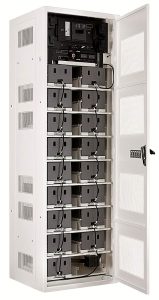
Li-Ion battery cabinets run approximately 30–50% smaller and about 60% lighter than equivalent VRLA configurations. In a co-location environment where floor space is priced per cabinet or per kW, freed battery room space has real dollar value — it can be reallocated to productive infrastructure. In an enterprise data center, reclaimed space defers expansion costs and accommodates IT growth that might otherwise require a build-out.
This tends to be underweighted in TCO discussions because it doesn’t appear as a line item on the battery quote. At the scale of a Galaxy VL or VX installation, however, the difference in battery cabinet footprint is significant enough to change how a data center floor is planned.
Maintenance: Knowing What You Actually Have
VRLA batteries degrade gradually and invisibly. A routine voltage check — which is what most sites rely on — does not reveal capacity loss. A battery string that passes a voltage check can still have lost 30–40% of its rated runtime capacity. The only reliable way to verify actual remaining runtime is a full discharge test under load, using a load bank under controlled conditions.
In practice, full discharge testing is rarely performed in mid-market environments. The cost is one barrier — it runs significantly more than a standard battery preventive maintenance visit, which is what most organizations budget for. A standard battery PM is worth doing: it covers visual inspection, connection checks, voltage readings, and thermal imaging, and it catches real problems. But it doesn’t measure actual available runtime under load.
Most UPS models display a runtime estimate in the front-panel menu, which can give a misleading sense of confidence. That estimate factors in current load and battery age — making it more useful than a voltage check alone — but it can overestimate available runtime because it doesn’t fully account for operating temperature history or the cumulative effect of prior discharge events on actual capacity. It’s an estimate, not a measurement.
Li-Ion’s integrated battery management system (BMS) changes this picture. The BMS monitors every cell continuously — voltage, temperature, state of charge, and state of health — in real time, reported through EcoStruxure IT. State of health and available runtime are estimated continuously from cell-level measurements, without routine discharge testing. For most mid-market organizations that aren’t running regular load-bank testing, that’s a meaningful improvement in understanding the real state of their infrastructure.
Recharge Time
Li-Ion recharges to 90% in 2–4 hours after a discharge event. VRLA takes 8–12 hours. If a facility is subject to recurring utility disturbances — or has experienced more than one event in a short period — the difference in recovery time matters.
Factor | VRLA | Li-Ion |
Battery service life | 3–5 years | About 10 years |
Replacement cycles (10-yr horizon) | 2–3 cycles | Typically none |
Capacity monitoring method | Periodic discharge test | Continuous BMS — real time |
Footprint vs. equivalent VRLA | Baseline | ~30% – 50% smaller and 60% lighter |
Recharge time to 90% | 8–12 hours | 2–4 hours |
Maintenance overhead | Higher — testing, coordination | Lower — BMS automates monitoring |
Upfront cost | Lower | Higher |
10-year TCO (typical) | Higher when cycles included | Lower when full costs included |
PART 2: OVERCOMING THE MYTHS ABOUT LI-ION SAFETY
The safety concerns about Li-Ion batteries are legitimate questions, and they deserve direct answers. In practice, most of the concern is based on a mismatch: the lithium chemistry used in laptops and smartphones — where thermal incidents have occurred — is being applied to UPS batteries, which use a fundamentally different chemistry in a fundamentally different system. Understanding that distinction is where an accurate safety evaluation has to start.
The Myth | The Facts |
Li-Ion batteries are dangerous — they catch fire. | UPS Li-ion batteries use chemistries selected for stability, NMC in Schneider Electric’s Galaxy and Smart-UPS Ultra lines and LFP in Smart-UPS Lithium-Ion models, both more thermally stable than the lithium cobalt oxide in consumer electronics. Schneider Electric’s BMS adds multi-layered protection: cell-level monitoring, thermal detection, and automatic disconnection. Batteries are certified to UL 1973, and installations follow NFPA 855. |
Li-Ion isn’t approved for regulated environments like healthcare or government. | Li-Ion UPS installations are governed by NFPA 855 and UL 9540, both of which are well-established standards with documented precedent across regulated occupancies including healthcare, government, and education. Schneider Electric provides full compliance documentation. Power Solutions can assist with any local code review for your project. |
The upfront cost is too high to justify. | On a 10-year total cost of ownership basis, Li-Ion typically comes out ahead when the analysis includes avoided replacement cycles, reduced maintenance requirements, and the opportunity cost of floor space. The upfront premium is real; the assumption that it makes Li-Ion more expensive over time usually isn’t. |
Li-Ion is new and unproven in UPS applications. | Schneider Electric has deployed Li-Ion UPS batteries at scale across healthcare, financial services, government, and enterprise data center environments for years. The technology is mature. Schneider Electric reports more than 500,000 Li-ion UPS units deployed since 2016 with no reported safety incidents. |
VRLA is good enough if you test it regularly. | Regular testing helps, but it doesn’t change the fundamental problem: VRLA degrades between tests, testing itself carries operational risk, and most organizations don’t test as frequently as manufacturers recommend. Li-Ion’s continuous BMS monitoring is not just more convenient — it provides materially better information about actual battery state. |
The Chemistry Difference Matters
Most high-profile lithium battery incidents involve lithium cobalt oxide (LCO) and other high-energy-density formulations used in laptops, smartphones, and some EV applications, where energy density is the primary design priority.
Schneider Electric UPS batteries use chemistries selected for stability and service life: nickel-manganese-cobalt oxide (NMC) in the Galaxy and Smart-UPS Ultra/Modular Ultra lines, and lithium iron phosphate (LFP) in Smart-UPS Lithium-Ion (SMTL) models. Both are more thermally stable than the lithium cobalt oxide (LCO) behind most consumer-electronics incidents. Chemistry is only the first layer of protection: cell safety devices, pack design, a multi-layered BMS, independent UPS protections, and UL 1973 / IEC 62619 certification add the rest. Schneider Electric reports more than 500,000 Li-ion UPS units deployed with no reported safety incidents.
The BMS Is Not a Single Control — It’s a System
Schneider Electric’s battery management system provides multi-layered protection that goes well beyond charge management. The BMS monitors each individual cell for voltage deviation, temperature anomaly, and state of health in real time. It manages charge and discharge rates to prevent the conditions that accelerate degradation. If any cell falls outside safe operating parameters, it disconnects the affected battery module or trips the battery cabinet’s breaker. And it feeds all of that data into EcoStruxure IT so developing issues can be identified before they become failures.
The BMS is both the mechanism that makes continuous monitoring possible and the primary safety control that distinguishes a purpose-designed UPS battery system from the consumer battery technologies that most safety concerns are drawn from.
Code Compliance Documentation
Li-Ion UPS batteries fall under NFPA 855 (Standard for the Installation of Stationary Energy Storage Systems) and UL 9540 (Standard for Energy Storage Systems and Equipment). Schneider Electric systems comply with UL 1973 (Standard for Batteries for Use in Stationary, Vehicle Auxiliary Power and Light Electric Rail Applications). These are well-established standards with solid precedent across healthcare, government, education, and commercial buildings.
For regulated occupancies where local code review is part of the installation process, Power Solutions provides a full compliance documentation package — product compliance certifications, NFPA 855 installation requirements, and guidance specific to the occupancy type. Li-Ion UPS installations are straightforward in most jurisdictions, and Power Solutions has supported the documentation process across a range of building types and regulatory environments.
Bottom Line on Safety
The safety question about Li-Ion UPS batteries has a clear answer once you’re working with the right chemistry comparison. A UPS-grade lithium-ion chemistry in a purpose-designed UPS system with a multi-layered BMS is not the same as the lithium batteries behind the incidents you’ve read about. The risk is substantially lower, and it is managed at every level.The risks are different in kind, not just in degree. If safety has been the reason for staying with VRLA, the actual facts are worth a fresh look.
WHERE LI-ION FITS: SCHNEIDER ELECTRIC UPS PORTFOLIO
Li-Ion battery options are available across Schneider Electric’s full UPS lineup — from compact single-phase units for smaller server rooms and edge locations to large three-phase systems for enterprise data centers.
- Smart-UPS Ultra — Compact single-phase rack and tower UPS for smaller server rooms, IDF closets, and edge locations. Li-Ion is available across the product family.
- Smart-UPS Modular Ultra (5–20 kW, single-phase) — Hot-swap modular architecture with N+1 redundancy; no maintenance bypass required for module service. Li-Ion is the native battery configuration.
- Galaxy VS (10–150 kVA, three-phase, 208V or 480V) — The right fit for medium-density data centers and critical facilities that need three-phase protection with internal N+1 redundancy and a compact footprint.
- Galaxy VL (200–500 kVA, three-phase) — Frame-level scalable architecture for large data centers. This is where Li-Ion’s footprint reduction has the most impact on floor planning.
- Galaxy VX (500–1,500 kVA, three-phase) — Enterprise and hyperscale data centers. ECOnversion mode reaches up to 99% efficiency while keeping the inverter active — not standard bypass.
NEXT STEPS
For organizations still running VRLA that haven’t revisited that decision recently, the conversation is worth having. The technology has matured, the TCO case is well-established, and the safety concerns — once the actual chemistry is understood — are more manageable than they appear from the outside.
For most organizations, a battery health assessment is the right starting point: measure actual load, evaluate battery condition, and get a clear picture of where things stand — along with an honest recommendation on whether Li-Ion makes sense for the specific application. For more in-depth information, see our whitepaper.
Talk to Power Solutions About Your Battery Options
Call us at 800-876-9373 or email [email protected] to discuss your environment and determine which battery chemistry is the right fit. Power Solutions has helped organizations across healthcare, education, financial services, government, and enterprise IT work through this decision.
Molly Gross, Principal at Power Solutions, LLC, has over 15 years of experience in critical power for enterprise and government applications. She has extensive knowledge of UPS and data center infrastructure with a specialization in services and product lifecycle management. Molly closely follows emerging trends and innovations in the critical power industry with an eye for incorporating leading edge technologies into both new construction and legacy infrastructures. Connect with Molly on LinkedIn.