
In the modern digital landscape, data centers serve as the backbone of global computing, housing vast arrays of servers, storage systems, and networking equipment that power everything from cloud services to artificial intelligence applications. As data processing demands escalate—driven by advancements in AI, big data, and edge computing—the heat generated by IT equipment has become a critical challenge. Effective cooling is essential not only to maintain optimal operating temperatures (typically between 18-27°C) but also to ensure energy efficiency, reliability, and scalability. Overheating can lead to equipment failures, reduced performance, and increased energy costs, potentially resulting in downtime that costs businesses millions. To address these issues, data center operators employ various cooling topologies, each tailored to different scales, densities, and operational needs. This essay explores four primary topologies: perimeter cooling, in-row cooling, in-rack cooling and hot-aisle/cold-aisle containment. We will examine their principles, advantages, disadvantages, and highlight relevant products from Schneider Electric, a leading provider of data center solutions, known for its comprehensive portfolio under brands like APC and Uniflair.
Perimeter Cooling
Perimeter cooling, also known as room-based cooling, represents the traditional approach to data center thermal management. In this topology, cooling units such as computer room air conditioners (CRACs) or computer room air handlers (CRAHs) are positioned along the perimeter of the data center room. These units draw in warm air from the room, cool it using refrigerants or chilled water, and distribute the cooled air through raised floors, overhead ducts, or diffusers. Hot air from the servers is then exhausted back into the room, creating a cycle that maintains a uniform temperature across the space. This method relies on centralized fans and airflow management to push cold air under the floor or from above, allowing it to rise through perforated tiles near the racks.
The advantages of perimeter cooling include its low initial capital costs and operational simplicity, as it does not require modifications at the rack level. It offers high flexibility, with adjustable floor tiles or diffusers enabling quick reconfiguration of airflow. For low-density environments (typically under 5-7 kW per rack), it provides inherent redundancy through shared cooling resources, making it suitable for phased expansions without complex overhauls. However, disadvantages arise as rack densities increase; inefficiencies from airflow mixing can create hotspots, leading to higher energy consumption unless supplemented with containment systems like hot-aisle barriers.
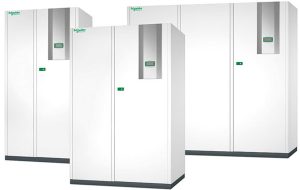
Schneider Electric offers robust perimeter cooling solutions emphasizing energy efficiency and modularity. The Uniflair Room Cooling series stands out as a high-capacity perimeter unit featuring efficient room cooling with a low cost of ownership. For instance, the Uniflair Small Room Cooling units offer precision cooling for loads 5-20kW with features like variable-speed fans and humidity control, ensuring reliable performance in diverse U.S. data center setups.
In-Row Cooling
In-row cooling advances the precision of thermal management by placing cooling units directly within the rows of server racks, typically in the cold or hot aisles. These units capture heat at its source, using direct expansion (DX), chilled water, or glycol-based systems to deliver targeted cold air to rack inlets while expelling hot air efficiently. This close-coupled approach minimizes the distance air travels, reducing the risk of temperature variations and improving overall airflow dynamics.
Key advantages include superior energy efficiency, with shorter airflow paths potentially saving over 50% on fan power compared to perimeter systems. It supports higher densities (up to 12 kW per rack), lowers operational costs, and enhances redundancy through N+1 configurations. By isolating cooling to active rows, it eliminates hotspots and integrates seamlessly with containment systems to optimize power usage effectiveness (PUE). On the downside, it introduces greater complexity in deployment and maintenance compared to room-wide systems, requiring careful row-level planning.
Schneider Electric excels in in-row solutions with products designed for flexibility and high-density applications. The Uniflair Direct Expansion InRow Cooling series provides close-coupled air, water, or glycol cooling for closets, server rooms, and data centers, featuring rack inlet temperature control and dual power inputs for reliability. Similarly, the Uniflair Chilled Water InRow Cooling targets medium to large data centers with chilled water systems, offering up to 30kW capacity and advanced monitoring. The InRow DX 300mm series further innovates with next-generation features for edge and cloud environments, ensuring efficient heat removal at the row level.
In-Rack Cooling
In-rack cooling represents the most granular topology, integrating cooling directly into or onto individual racks. This can involve rear-door heat exchangers, coolant distribution units (CDUs), or hybrid air-liquid systems that circulate coolant through cold plates or manifolds attached to servers. By addressing heat at the component level, this method achieves precise temperature control without relying on room-wide airflow.
Advantages encompass rapid deployment and scalability for extreme densities (up to 100 kW or more per rack with liquid hybrids), reducing energy costs through targeted cooling and potentially lowering PUE by 30% in dense setups. It offers built-in redundancies for superior uptime and flexibility, making it ideal for hyperscale operations or AI-driven workloads. However, the primary disadvantage is higher upfront costs, though these are often offset by long-term savings in efficiency and reduced infrastructure needs.
Schneider Electric’s in-rack offerings, mostly through its Motivair subsidiary, provide cutting-edge solutions for high-performance computing. The ChilledDoor® Rear Door Heat Exchanger (RDHx) handles up to 75 kW per rack with active PLC controls, hot-swappable fans, and leak detection for secure operation. The In-Rack Heat Dissipation Unit (HDU™) enables liquid cooling in air-only environments, featuring N+1 redundancy and remote monitoring in a compact form. Additionally, the In-Rack CDU supports 105 kW capacity in a 4U space with automatic flow adjustments, ideal for dense AI deployments. The Uniflair Rack Mounted Room Cooling further complements this for micro data centers and edge computing, providing targeted cooling to meet specific needs.
Hot-Aisle/Cold-Aisle Containment
Hot-aisle/cold-aisle containment is a widely adopted airflow management strategy that enhances the efficiency of data center cooling topologies by physically separating cold intake air from hot exhaust air. In this design, server racks are arranged in alternating rows where the fronts of the racks face each other to form “cold aisles” supplied with chilled air, while the backs face each other to create “hot aisles” where warm air is expelled. Containment systems, such as doors, panels, roofs, or curtains, enclose these aisles to prevent the mixing of hot and cold air streams, which can otherwise lead to inefficiencies like hotspots, recirculation, and increased energy use. This approach can improve cooling capacity by up to 40%, reduce fan energy consumption, and lower overall PUE by allowing higher supply air temperatures without compromising equipment reliability.
Containment is versatile and complements all three cooling topologies discussed. In perimeter cooling, it addresses airflow mixing issues in large rooms by directing cold air more precisely through raised floors. For in-row cooling, it enhances targeted heat removal by isolating rows, enabling higher densities. In in-rack setups, it supports hybrid systems by maintaining segregated airflows at the granular level. Benefits include better predictability of cooling performance, scalability for growing densities, and compliance with standards like ASHRAE TC9.9 for thermal guidelines. However, implementation requires careful planning to avoid over-pressurization, ensure fire safety (e.g., with drop-away panels for sprinklers), and accommodate cabling or maintenance access. While initial costs for retrofits can be a drawback, the long-term savings in energy and operational efficiency often justify the investment.
Schneider Electric provides a range of containment solutions integrated with their APC and Uniflair brands to support both hot-aisle and cold-aisle configurations. The APC NetShelter Aisle Containment system is a modular solution designed for rack, row, or room-level containment, featuring sliding doors, roofs, and end panels to maximize cooling efficiency and predictability. Specific components include the ACDC2400 Aisle Containment Door Sliding, which offers secure, automated access with motion sensors, and the ACDC2402 Door Header compatible with 42U VX and 45U SX cabinets for effective air segregation. Additionally, the EcoAisle Containment System provides intelligent features like LED lighting with motion detection, proxy card security, and thermal event detection, supporting both hot and cold aisle setups while ensuring full sprinkler access. These products integrate seamlessly with Schneider electric’s broader EcoStruxure platform for monitoring and optimization, making them ideal for data centers aiming for sustainability and high performance.
Conclusion
Data center cooling topologies—perimeter, in-row, and in-rack—offer a spectrum of solutions to balance cost, efficiency, and density requirements in an era of escalating computational demands. Perimeter cooling suits cost-effective, low-density setups; in-row provides efficient mid-range scalability; and in-rack excels in high-density, precision environments. The integration of hot-aisle/cold-aisle containment further amplifies these benefits by optimizing airflow and reducing energy waste across topologies. Selecting the right topology and containment strategy depends on factors like rack density, budget, and future growth projections. Schneider Electric, with its extensive portfolio including the Uniflair series, Motivair innovations, and APC NetShelter containment systems, plays a pivotal role in enabling these solutions through reliable, energy-efficient products that integrate seamlessly with broader EcoStruxure platforms. As data centers evolve, adopting hybrid approaches and advanced monitoring will further optimize performance, ensuring sustainability and resilience in the digital age.
The Cooling Experts at Power Solutions, LLC can help identify and design the most effective and cost-efficient cooling configuration for your space. For more information, call 800-876-9373 or email [email protected].